

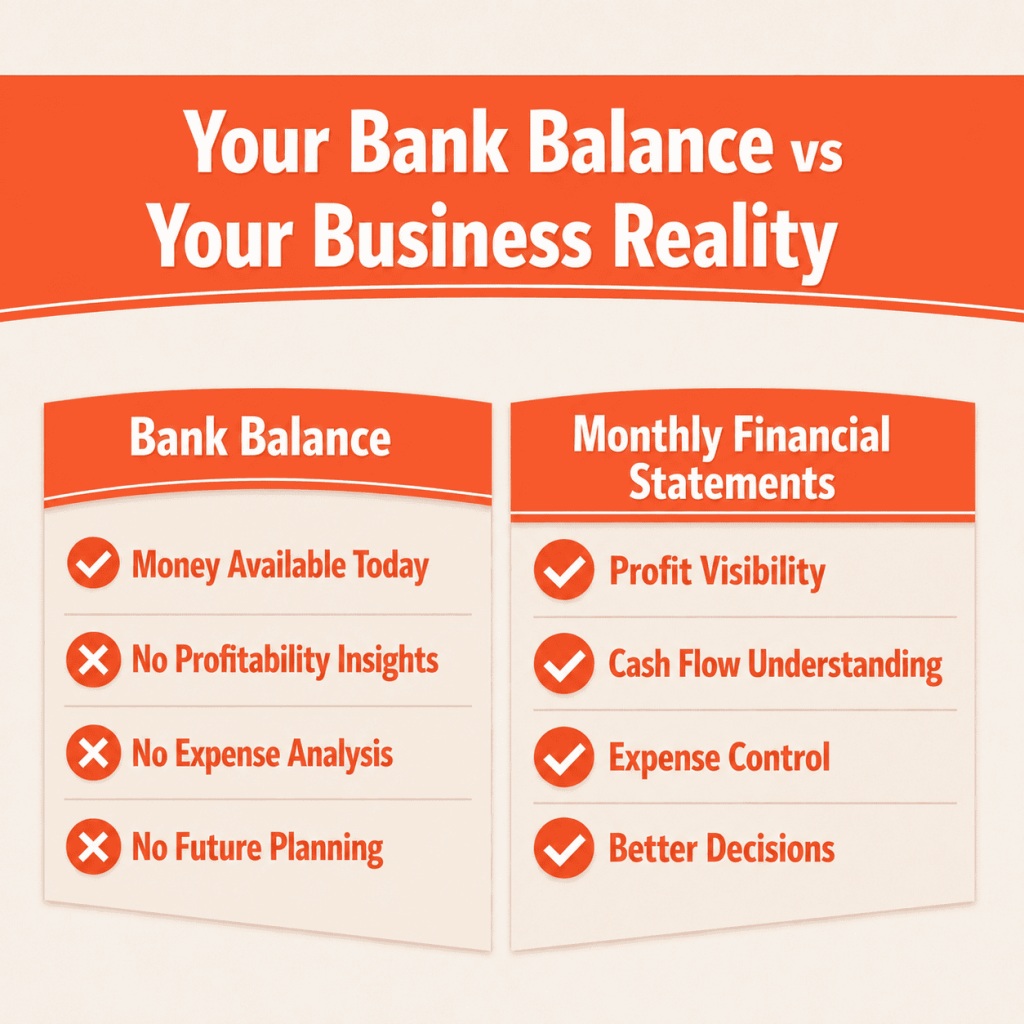
Running a business in the UAE today requires more than increasing sales and attracting customers. Business owners need to understand what is happening behind those sales numbers. Many SME owners review their bank balance every few days and assume that everything is under control. However, the bank balance only shows how much money is available today. It does not explain whether the business is profitable, whether expenses are increasing, or whether customers are delaying payments. A company can have impressive revenue figures but still struggle with cash flow. Another company may have lower sales but stronger profitability because it manages expenses efficiently.
The difference often comes down to one factor:
How frequently does the business review its financial performance?
Monthly financial statements provide UAE businesses with a clear picture of their financial position, helping owners move from reactive decision-making to proactive business management.
The Hidden Problem Many UAE SMEs Face: Running a Business Without Financial Visibility
Many SMEs focus heavily on operations:
- Getting new customers
- Managing employees
- Delivering services
- Increasing sales
But financial monitoring often becomes a year-end activity. By the time annual accounts are prepared, business owners may discover:
- Certain services are generating losses
- Operating costs have increased significantly
- Customers have outstanding payments
- Inventory levels are affecting cash flow
- Expenses were higher than expected
At that stage, correcting the problem becomes much harder. Monthly financial statements act like a business health check. Similar to how individuals monitor their health regularly instead of waiting for a serious issue, businesses need regular financial reviews to identify risks early.
What Are Monthly Financial Statements?
Monthly financial statements are structured financial reports prepared at the end of each month to provide business owners with a clear understanding of their company’s financial performance and position. For many UAE SMEs, financial reporting is often associated only with year-end accounting, audit requirements, or tax filing. However, waiting until the end of the financial year to review business performance can leave owners making decisions based on outdated information. Monthly financial statements act as regular financial health checks. They convert daily business transactions into sales, purchases, expenses, payments, and investments into meaningful insights that help management understand what is happening inside the business.
Simply put, monthly financial statements answer three important questions:
1. Is my business making money?
2. Where is my money being spent?
3. Is my business financially strong enough for future growth?
For UAE SMEs operating in a competitive market, these insights are valuable because they allow business owners to identify opportunities, control costs, manage cash flow, and make decisions based on accurate financial data rather than assumptions.
Three Core Financial Statements Every SME Should Review Monthly
1. Profit and Loss Statement (P&L): Understanding Business Profitability
The Profit and Loss Statement, also known as the Income Statement, shows whether the business generated a profit or loss during a specific period.
2. Balance Sheet: Understanding the Financial Position of Your Business
While the Profit and Loss Statement shows business performance, the Balance Sheet shows the overall financial position of the company at a particular point in time.
3. Cash Flow Statement: Knowing Where Your Money Goes
This is one of the biggest financial challenges faced by SMEs. A business can be profitable but still struggles to pay suppliers, salaries, or operational expenses because cash is tied up elsewhere.
Why Monthly Financial Statements Are Important for UAE SMEs
Running a successful SME in the UAE is about much more than increasing sales. Business owners are expected to manage employees, maintain customer relationships, adapt to market changes, comply with regulations, and make strategic decisions, all while keeping the business financially healthy. In such an environment, relying on intuition or checking your bank balance is no longer enough. Every important business decision should be supported by reliable financial information, and that is exactly what monthly financial statements provide.
Unlike annual financial reports, which offer a retrospective view of the business, monthly financial statements provide timely insights. They allow business owners to understand current performance, identify emerging challenges, and take corrective action before small issues become costly problems. Here are some of the key reasons why monthly financial statements are essential for UAE SMEs.
- They Give You Control Over Your Business Performance
- They Help Businesses Manage Cash Flow More Effectively
- They Support Better Business Decisions
- They Improve Cost Control and Operational Efficiency
- They Keep Businesses Prepared for UAE Corporate Tax and VAT Compliance
- They Make Audits Faster and Less Disruptive
- They Build Confidence with Banks, Investors, and Business Partners
- They Help Business Owners Measure Growth, Not Just Revenue
- They Encourage Proactive Rather Than Reactive Management
Monthly Reports Turn Information into Action
Monthly financial statements are much more than compliance documents prepared for accountants or tax authorities. They are practical management tools that help business owners understand where the business stands today and where it is heading tomorrow. For UAE SMEs operating in a fast-changing business environment, reviewing financial performance every month provides the clarity needed to control costs, improve profitability, strengthen cash flow, and make informed strategic decisions.
Why Year-End Financial Statements Alone Are Not Enough
Some SMEs prepare accounts only once a year because they believe annual reporting is sufficient. While annual financial statements are important, they provide historical information.
They tell you:
“What happened last year?”
Monthly financial statements answer a more important question:
“What is happening in my business right now?”
The business environment changes quickly. Supplier prices change, customer behavior changes, and market conditions shift. Waiting 12 months to review financial performance can result in missed opportunities and delayed corrective actions.
Key Financial Reports Every UAE SME Should Review Monthly
Apart from the main financial statements, businesses should monitor:
Accounts Receivable Report
- Customers delaying payments
- Outstanding invoices
- Collection issues
Expense Analysis Report
- Where money is being spent
- Unnecessary expenses
- Cost-saving
Sales Performance
- Revenue growth
- Product performance
- Customer trends
Budget vs Actual Report
- Planned expenses
- Actual expenses
Monthly Financial Statements and Business Growth: The Connection
Every business owner dreams of growing their business by expanding into new markets, hiring more employees, launching new products, or opening additional branches. While ambition and hard work are essential, sustainable growth is built on one critical factor: making informed decisions based on accurate financial information. Many SMEs believe growth is measured only by increasing sales or acquiring more customers. However, experienced business leaders understand that growth is meaningful only when it is profitable, sustainable, and financially manageable. This is where monthly financial statements become an invaluable management tool.
Rather than simply recording past transactions, monthly financial statements provide a roadmap for future decisions. They help business owners evaluate whether the business is ready for expansion, identify potential risks, and allocate resources more effectively.
Should SMEs Prepare Monthly Financial Statements Internally or Outsource?
For many small and medium-sized enterprises (SMEs) in the UAE, preparing monthly financial statements is no longer just an accounting exercise; it is an essential part of running a successful business. However, one question frequently arises as businesses grow:
Should monthly financial statements be prepared by an in-house team, or is it better to outsource the process to a professional accounting firm?
The answer depends on several factors, including the size of the business, the complexity of its operations, the available budget, and the level of financial expertise within the organisation. Both approaches have their advantages, but for many growing SMEs in the UAE, outsourcing has become an increasingly practical and cost-effective solution.
Why Many UAE SMEs Choose to Outsource
Outsourcing accounting has become a preferred option for many SMEs because it allows businesses to access professional expertise without the costs associated with maintaining a full-time finance department. Instead of hiring multiple specialists, businesses gain access to an experienced team that supports various aspects of financial management.
Professional accounting firms typically assist with:
- Bookkeeping and transaction recording.
- Monthly financial statement preparation.
- Management reporting.
- VAT compliance and return preparation.
- Corporate Tax support.
- Financial reconciliations.
- Year-end financial statement preparation.
- Audit support.
This enables business owners to focus on running and growing the business while experienced professionals manage financial reporting.
How RVG Helps UAE SMEs Build Better Financial Visibility
At RVG Chartered Accountants, we support UAE businesses with reliable accounting and financial reporting solutions designed for SME requirements. Our accounting services help businesses maintain accurate records, understand their financial position, and make informed decisions. From monthly bookkeeping to financial reporting and tax compliance support, our team helps businesses create a strong financial foundation for sustainable growth.
Conclusion: Monthly Reporting Is Not an Expense, It Is a Business Investment
For UAE SMEs, financial statements should not be viewed as documents prepared only for tax filing or year-end reporting. They are decision-making tools that help business owners understand performance, manage cash flow, control costs, and plan future growth. A business that reviews its numbers every month is better prepared to identify opportunities, manage risks, and build long-term success. In today’s competitive UAE market, financial visibility is not optional, it is a necessity.


